
Review · ATHENS
The best of Athens Piraeus Full-Day Private Shore Excursion
The Acropolis is the star here, but this private day goes well beyond the Parthenon. In about eight hours, you can move from the rocky citadel of ancient Athens to neoclassical squares, a marble Olympic stadium, a lively old neighborhood, and the high viewpoint of Mount Lycabettus.
I like two things in particular: the private vehicle, which saves you from managing Athens transport after a long sea day, and the freedom to adjust the route. You can spend more time at the Acropolis, shorten a museum visit, or keep the city sights moving if your ship schedule is tight.
The main thing to consider is cost. At $499.74 for up to three people, this is not a budget outing. Admission fees, meals, and a licensed guide are extra, so the final total can rise quickly.
Key points to know before you book
- Piraeus pickup is direct and simple: Meet your driver outside Terminal A at E11, holding a sign with your name.
- The route covers more than fifteen major sights: Expect ancient monuments, government buildings, museums, historic neighborhoods, and city viewpoints.
- The driver explains the sites from outside: A licensed guide is not included inside the Acropolis, museums, or archaeological sites.
- Tickets are not included: Pre-purchasing is strongly suggested, especially for the Acropolis and Acropolis Museum.
- Mount Lycabettus gives you a final citywide view: The hill rises 277 meters above Athens and looks toward the city and coast.
- The group is fully private: Only your party takes part, with transportation sized for your group.
From Piraeus to the Acropolis in a private car
Your day begins at 8:00 a.m. at Piraeus Port. For a cruise pickup, leave the ship, walk outside the terminal exit, and look for a driver holding a sign with your name. The stated meeting point is Terminal A, 28 Akti Xaveriou Street, Port E11.
That clear meeting plan matters. Piraeus is a large working port, and cruise terminals can feel confusing after disembarkation. Have your ship name, docking time, disembarkation time, and reboarding time ready when you book. The same service can collect you from an Athens hotel and return you to that same location.
The drive toward Athens follows the coast of the Saronic Gulf and the Athens Riviera. It is a pleasant way to begin because you get a sense of the link between the port and the capital instead of simply appearing in the center by taxi or metro.
From Piraeus, Athens is about 12 kilometers away. The route then heads toward the Acropolis, the ancient citadel on its rocky hill. Your driver can explain the setting and the monuments before you enter, but remember that the driver is not licensed to guide you inside the sites.
More Private Shore Excursions in Athens
- Essential Athens Full Day Private Tour – Best Shore Excursion
★ 5.0 · 168 reviews - The Highlights of Athens Private Shore Excursion 8 Hours
★ 5.0 · 39 reviews - Embark | Disembark The Highlights Of Athens – 4 H Private Shore Excursion
★ 5.0 · 35 reviews
The Acropolis: Parthenon, Propylaea, and Athena Nike
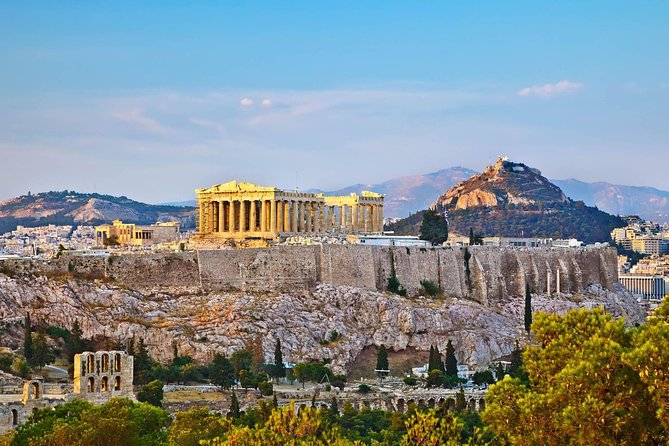
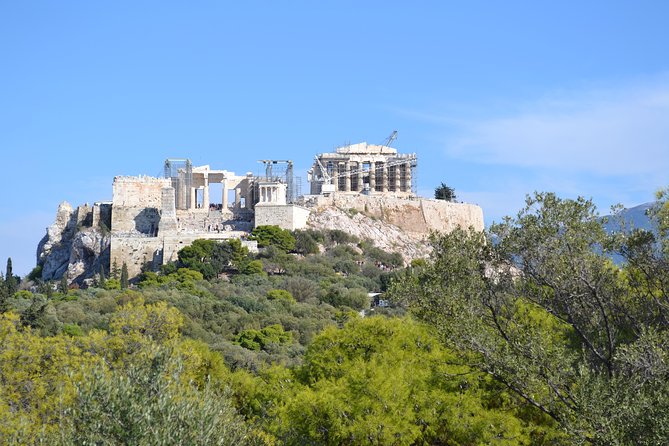
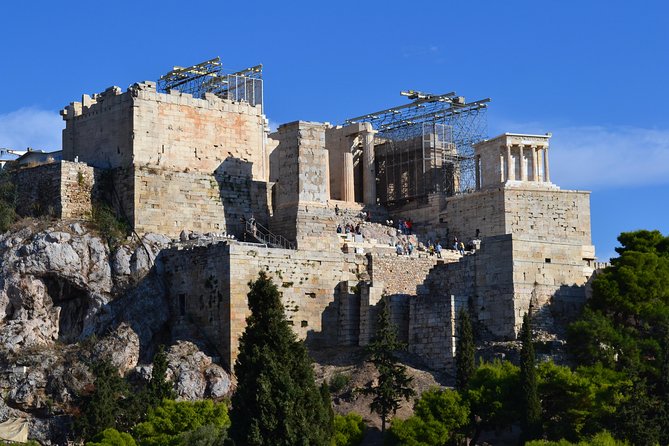
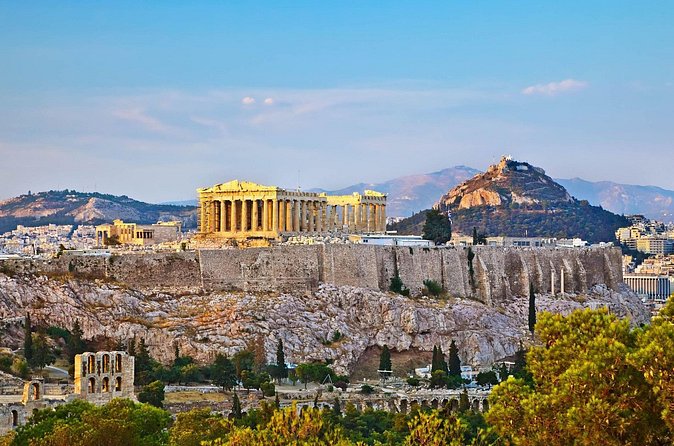
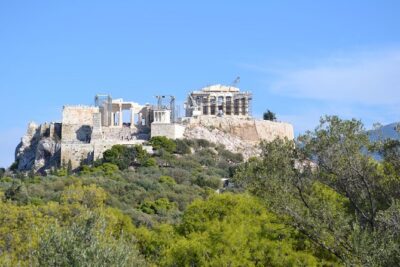
The Acropolis is the part of the day that needs the most planning. It contains the Parthenon, the Propylaea, the Temple of Athena Nike, and the Erechtheion, all within a compact but uneven hilltop area.
The Propylaea is the monumental gateway. Built during the great fifth-century BC building program, it frames the entrance with Pentelic marble. Its design was ambitious and never fully completed, but the approach still gives you a powerful sense of crossing from modern Athens into the sacred precinct.
The small Temple of Athena Nike sits on a bastion near the entrance. Its name means Athena of Victory. Ancient Athenians depicted the goddess without wings so she would not leave the city. It is easy to pass this small temple while focusing on the Parthenon, so having the driver point it out before you enter is useful.
The Parthenon deserves the longest look. Built between 447 and 438 BC under Pericles, it was dedicated to Athena Parthenos, the city’s patron. Architects Ictinus and Kallikrates designed it, while Pheidias supervised the sculptural program. The building is famous for its Doric form, but its subtle curves and carefully calculated proportions are just as interesting.
The Erechtheion, on the north side, has a different character. Its porch with the six female figures known as Caryatids is one of the most recognizable sights on the hill. The original figures are protected, with five now in the Acropolis Museum and one in the British Museum. The figures you see on the building are casts.
You are given about fifteen minutes at both the Propylaea and Temple of Athena Nike, forty-five minutes at the Parthenon, and fifteen minutes at the Erechtheion. That timing gives you a solid introduction, but it is not a slow archaeological study. If the Acropolis is your main reason for coming to Athens, ask to protect enough time for the hill and consider trimming a less important stop.
Admission is not included, and tickets should be arranged in advance. The operator can purchase them for you for a small service fee. That may be worthwhile during busy periods, since arriving without availability could upset the whole day.
Wear practical shoes and expect a moderate level of physical activity. The Acropolis involves walking on uneven surfaces and moving between several exposed areas. The tour supplies transportation, not a way to avoid the walking once you are inside.
Syntagma Square and the Evzones
After the Acropolis, the route moves into modern Athens around Syntagma Square. Here you see the Hellenic Parliament, the Tomb of the Unknown Soldier, and the ceremonial Evzone guards.
The former royal palace now houses the Parliament. Its marble construction began in 1836 after Otto became king and Athens became the capital of the modern Greek state. The building reflects the early years of that state, when the new capital was being laid out around grand public institutions.
The Tomb of the Unknown Soldier sits in front of Parliament. It honors Greek soldiers killed in war and is guarded by the Presidential Guard. The guards wear the traditional fustanella, a pleated kilt with 400 folds representing the years of Ottoman rule. The uniform takes around eighty days to make by hand.
The changing of the guard takes place every hour. Since your timing may not line up perfectly, ask your driver about the best chance of seeing it. The short stop at the Parliament and the fifteen minutes at the monument give you time for photographs and orientation, but the complete ceremony may require careful timing.
Behind Parliament, the National Garden offers a welcome change from stone and traffic. Queen Amalia ordered the gardens in 1839, and designer Friedrich Schmidt searched widely for plants and trees. Today the garden covers more than 160,000 square meters and contains more than 500 types of plants and trees.
The Neoclassical Trilogy and Old Athens
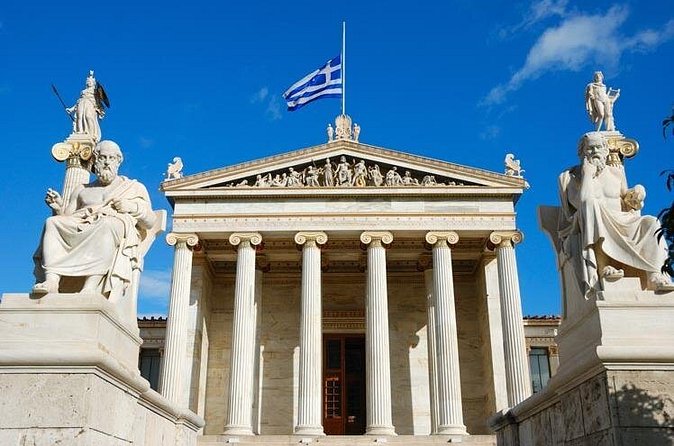
The next part of the route passes three important neoclassical buildings: the Academy of Athens, the National and Kapodistrian University, and the National Library of Greece.
The Academy was founded in 1926 as an institution for science, humanities, and fine arts. The university, opened in 1837, was the first university in the modern Greek state and the first in the Balkans and eastern Mediterranean. The National Library completes the group, with collections that include more than one million books and magazines, plus handwritten codices dating from the ninth to nineteenth centuries.
The planned stops are brief, about five minutes each. That makes sense if you want a broad view of Athens, but these are primarily exterior visits. You will have time to appreciate the buildings and take photographs, not to study their collections or interior spaces.
The route also passes the Old Parliament Building, now home to the National Historical Museum. The building housed the Greek Parliament and Senate for about sixty years before Parliament moved to the former royal palace in Syntagma Square. The museum covers the period from Ottoman and Latin rule through the War of Independence and the development of modern Greece.
Syntagma Square ties these sights together. Its name means Constitution Square, recalling the uprising of September 3, 1843, when King Otto accepted a constitution. The square has been the setting for major public events ever since, making it more than a place to pass through on the way to lunch.
More Private Shore Excursions in Greece
- Athens Highlights Shore Excursion Full Day Private Tour
★ 5.0 · 26 reviews - Athens Shore Excursion: Private City Sightseeing and Acropolis Tour
★ 4.5 · 22 reviews - Half Day Private Athens Shore Excursion
★ 5.0 · 20 reviews - Athens Private Group Shore Excursion
★ 4.5 · 18 reviews
Plaka: lunch and a slower hour
Plaka is where the day can feel less formal. The district lies below the Acropolis and has narrow streets, neoclassical houses, small shops, cafes, and family-run tavernas. You get about an hour and a half here, including free time for lunch.
I like having this pause built into a long sightseeing day. Eight hours of monuments and museums can blur together, while Plaka gives you room to sit down, eat, browse, and decide what deserves your attention next.
Anafiotika, a small area within Plaka, has whitewashed houses and a Greek-island feel. The streets can be narrow and uneven, so keep your shoes practical. Lunch is not included, and you choose where and what to eat.
Plaka is also useful for shopping. You might find jewelry, clothing, ceramics, and other local goods, but prices vary from shop to shop. If you want a relaxed meal rather than another timed visit, this is one of the most valuable parts of the day.
Ancient Agora and the Acropolis Museum
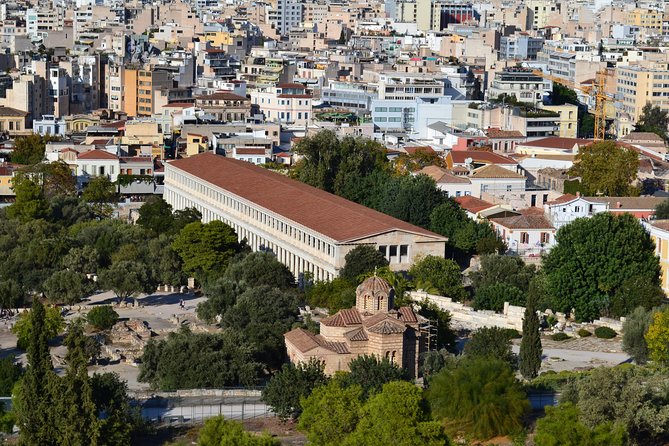
The Ancient Agora lies northwest of the Acropolis. For roughly 5,000 years, this area served at different times as a place for assemblies, commerce, homes, and public life. The surviving remains show layers from the Archaic, Greek, Roman, and Byzantine periods.
You have about forty minutes here. That is enough to see the main remains and understand how the Agora functioned, though a longer visit would suit anyone particularly interested in ancient civic life.
The Acropolis Museum is given about ninety minutes. It focuses on finds from the Acropolis and its slopes, covering material from the Greek Bronze Age through Roman and Byzantine times. The building opened in 2009, about 300 meters from the Acropolis, and was designed by Bernard Tschumi with Michael Photiades.
This museum is especially useful after seeing the hill. You can look more closely at the sculpture and architectural details that are difficult to study outdoors. Again, admission costs extra, and your driver can explain the site before you enter but cannot accompany you inside without a separately arranged licensed guide.
If you want both the Agora and museum to receive their proper attention, tell the driver early in the day. The route includes many stops, and private touring works best when you make your priorities clear.
Olympian Zeus, Kallimarmaro, and Mount Lycabettus
The sanctuary of Olympian Zeus is another ancient stop, located between the Acropolis and the Ilissos River. The huge temple was dedicated to Zeus and was once among the great marble buildings of the ancient world. The ruins help you understand the scale of ancient Athens, even if your time there is mainly for viewing from the outside.
Kallimarmaro, or the Panathenaic Stadium, provides one of the day’s most distinctive photographs. Built entirely of Pentelic marble, it hosted the first modern Olympic Games in 1896. The same type of marble was used for major monuments including the Acropolis and the Temple of Olympian Zeus.
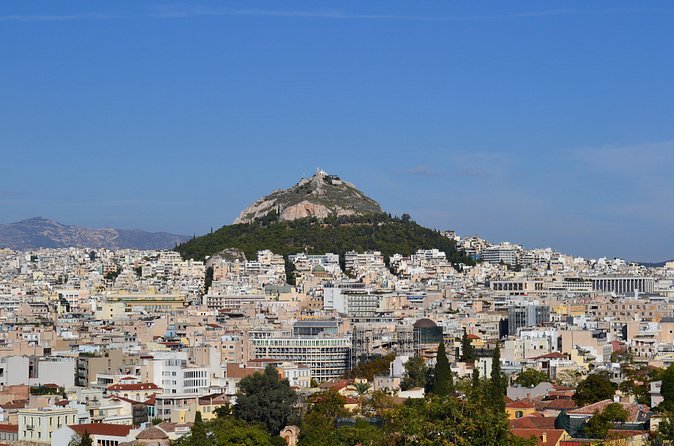
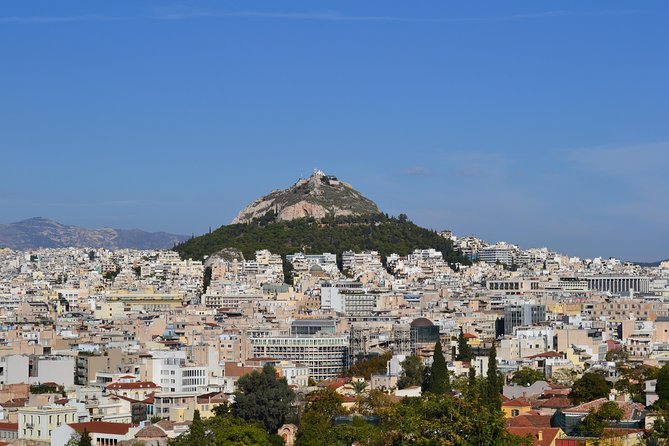
The final major stop is Mount Lycabettus. At 277 meters, it is the highest point in central Athens and offers views over the city and toward the coast. A small chapel of Saint George sits at the top, and the hill can be reached on foot, by funicular, or by car.
You have about seventy minutes at Lycabettus, which is generous compared with some of the brief architectural stops. The hill gives you a chance to see how Athens fits together after spending most of the day among individual buildings.
The route ends with drop-off at the same place where you began. For a cruise passenger, that means returning to Piraeus. Build in enough time for the drive back and your ship’s boarding deadline. Traffic conditions can affect the schedule, so do not treat the full eight hours as a reason to plan an unusually close return.
What the $499.74 price really buys
The price is $499.74 per group of up to three people, not per person. For three people, that works out to roughly $167 per person before entrance fees, meals, and any licensed guide. For two people, the per-person cost is higher, but you still receive a private vehicle and a route tailored to your pace.
The value is strongest when you want control. You are not tied to a large group’s walking speed, and you do not need to arrange separate transport between Piraeus, the Acropolis, Plaka, the museum, and Lycabettus. The vehicle is air-conditioned and sized for your party.
The price is less attractive if you only want the Acropolis and a quick drive through Athens. In that case, a shorter transfer and a separate site visit may cost less. This full day makes more sense if you want to cover many parts of the city during one port call.
A licensed guide costs extra. The English-speaking driver has good knowledge of Greek culture and history, but cannot guide you inside the archaeological sites and museums. That distinction is important. If detailed interpretation inside the Acropolis or museum matters to you, arrange the additional guide before the day of the tour, since availability is not guaranteed.
One driver named Michael is specifically praised for arriving at the agreed times and adapting to the group’s needs. That is exactly the service quality you want on a port day, although driver assignment can vary.
Who should book this Athens shore excursion?
I would consider this a good match for a small group that wants a broad first look at Athens without handling transport. It suits families or friends who can divide the cost and want to choose their own balance of ancient sites, museums, viewpoints, food, and shopping.
It also works well for cruise passengers who prefer a direct pickup and return. The private format gives you a better chance of adjusting the day if you are tired, if a site takes longer than expected, or if you decide Plaka deserves more time.
You should think twice if your main goal is expert guiding inside every monument. The driver’s role ends at the entrance unless you pay for a licensed guide. You should also budget for tickets before comparing the total price with other Athens tours.
Free cancellation is available up to 24 hours before the start time. Changes or cancellations made less than 24 hours ahead are not accepted for a refund.
Should you book it?
Book this tour if you want maximum coverage with private transport, especially during a cruise stop. The Acropolis, Syntagma, Plaka, Ancient Agora, Acropolis Museum, Kallimarmaro, and Lycabettus give you a strong overview of both ancient and modern Athens.
Before paying, decide which two or three sights matter most to you, reserve admission in advance, and consider adding a licensed guide. With those details settled, the $499.74 group price can be fair for three people who value time and flexibility. If you prefer a slow museum day or need only a transfer to the Acropolis, choose a shorter and more focused option instead.
FAQ
Where does the tour begin for cruise passengers?
Pickup is at Piraeus Port, Terminal A, 28 Akti Xaveriou Street, Port E11. After leaving the terminal, walk outside the exit door and look for the driver holding a sign with your name.
What time does the tour start?
The stated start time is 8:00 a.m.
Is the tour private?
Yes. Only your group participates, and the price covers up to three people.
Are entrance fees included?
No. Admission fees for archaeological sites and museums are not included. Pre-purchasing tickets is suggested, and the operator can buy them in advance for a small service fee.
Can the driver guide me inside the Acropolis and museums?
The English-speaking driver can explain the sites until you enter, but drivers are not licensed to accompany visitors inside archaeological sites and museums. A licensed state guide can be arranged for an additional cost, subject to availability.
Can I cancel for a full refund?
You can cancel up to 24 hours before the experience starts for a full refund. Cancellations or changes made less than 24 hours before the start time are not accepted.
More full days ashore around Athens
- Full Day Cruise-Friendly Tour of Athens from Piraeus Port
★ 4.0 · 14 reviews - Biblical Full Day Private Shore Excursion Athens-Corinth
★ 5.0 · 12 reviews - Full Day Private Athens Shore Excursion
★ 5.0 · 6 reviews - Athens-Ancient Corinth Biblical Full Day Private Shore Excursion
★ 5.0 · 4 reviews
Fresh shore excursions around Athens
- The Golden Age of Athens 6H private shore excursion -With Tickets★ 5.0 · 2 reviews
- “Athens in a Glimpse with Cruise Port Pickup & Drop-Off”★ 5.0 · 16 reviews
- Shore Excursion: Argolida -Mycenae, Nafplio and Epidaurus Private Day Trip★ 4.5 · 2 reviews
- Private Shore Excursion Driving Tour of Athens Best and Athenian Riviera★ 5.0 · 2 reviews
- Private Shore Excursion: Sightseeing of Athens and the Acropolis★ 5.0 · 3 reviews
- Athens City Tour with Acropolis & Plaka from Piraeus Cruise Port★ 4.5 · 26 reviews
- Pireaus Cruise terminal to Athens city center★ 5.0 · 2 reviews
- Best of Athens: Private Guided Half-Day Tour & Shore Excursion★ 5.0 · 2 reviews
Athens Shore Excursions, compared.
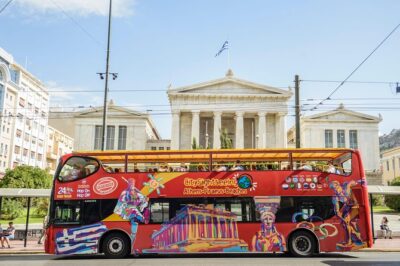
Athens Shore Excursion: Athens and Piraeus Hop-On Hop-Off Bus Tour
Read our review →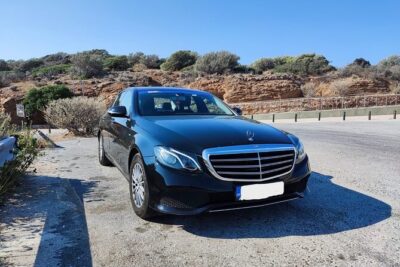
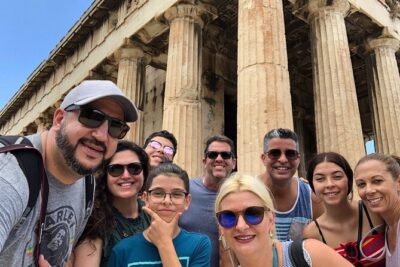
Essential Athens Full Day Private Tour – Best Shore Excursion
Read our review →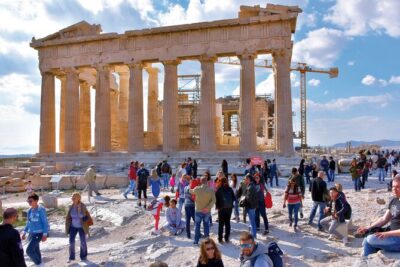
Athens Shore Excursion: Acropolis Walking Tour
Read our review →
From Cruise Port: The Acropolis & Athens Highlights Tour
Read our review →
Athens for CRUISE SHIPS with opt. Acropolis from Piraeus Port
Read our review →
Browse the lists this tour appears in