
Review · CARTAGENA
Private 4-hour Shore Excursion of Cartagena with driver and official guide
Cartagena packs Roman ruins, Carthaginian defenses, naval treasures, and modernist architecture into a walkable Spanish port. This private four-hour tour gives you a driver for the wider sights and an official guide for the places where context matters most, especially the Roman Theater.
I like the clear mix of indoor museums and outdoor archaeology, and I like that pickup can be arranged at your cruise port, hotel, or another spot in Cartagena. The main caution is the price, $487 per person, plus several entrance fees not included. English ability may also vary by guide.
Key points at a glance
- Roman Theater included: Your admission covers Cartagena’s major ancient monument and its well-designed museum.
- Private transport: A driver and vehicle save time between the port, hilltop viewpoints, and archaeological sites.
- Several eras in four hours: The route links Carthaginian, Roman, medieval, naval, and modernist Cartagena.
- Guide quality matters: David earned especially strong praise for his warm, entertaining explanations, but one report noted some difficulty with English.
- Extra fees add up: The castle, Punic Wall, and ARQUA are not included in the base price.
- A recent service concern: One customer reported an unpleasant driver experience. The provider apologized and said that driver was removed from the company.
Cartagena in four hours, from Carthage to modern Spain

This is not simply a bus ride past old buildings. The route follows the layers that make Cartagena interesting: Qart Hadast, the Carthaginian city founded by General Hasdrubal in 229 BC; Roman Carthago Nova; medieval fortifications; Spanish naval history; and the modern city rebuilt during its industrial boom.
A private format helps because the city’s sights are close together but not all in the same setting. The Naval Museum, Roman Theater, and old center suit a walking visit. The Castle of the Conception requires a climb or panoramic elevator. The Punic Wall and ARQUA add more history, but each has its own admission arrangements.
You receive four hours of private guiding and a private vehicle with driver. That does not mean four hours of nonstop driving. The vehicle is most useful for reaching the higher part of town and keeping the schedule practical during a cruise stop.
The tour’s rating is 4.3 from four reviews, a small sample. Three reviews give the experience four or five stars, with particular praise for the Roman Theater, the guide David, reliable pickup, and a comfortable pace. One three-star review raises a serious service concern about the driver. The provider replied that the issue involved a language misunderstanding, apologized, and said the driver had been removed.
More Private Shore Excursions in Spain
- Private Excursions For Cruise Ship Passengers
★ 4.5 · 110 reviews - Palma de Mallorca Shore Excursion: Private Tour of Valldemossa, Soller and Serra de Tramuntana
★ 5.0 · 65 reviews - Private Shore Excursion to Valldemossa and Palma de Mallorca
★ 4.5 · 43 reviews
The Naval Museum and Cartagena’s seafaring identity
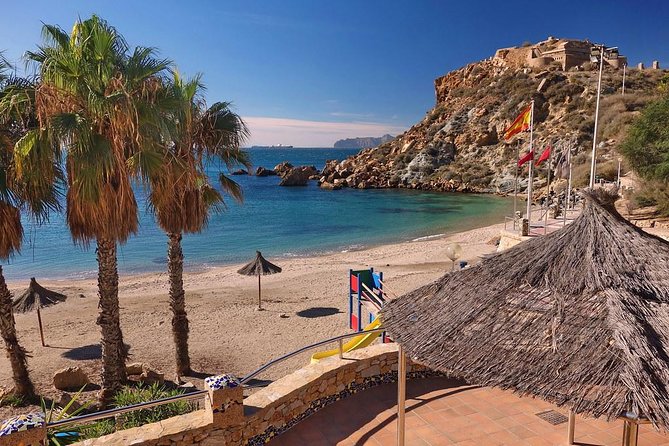
Your first listed stop is the Museo Naval, with about 40 minutes inside. Admission is included at no charge, so this is an efficient way to add a museum without increasing the tour cost.
The museum covers the Spanish Navy, shipbuilding, nautical science, cartography, navigation instruments, maritime voyages, underwater archaeology, and maritime traditions. That range gives your guide plenty of material for explaining why Cartagena has long been tied to the sea.
I would pay attention to how the museum connects technical subjects with human journeys. Maps, instruments, and shipbuilding can feel dry when seen without context. With an official guide, you can ask which objects matter most and avoid spending your limited time on displays that interest you less.
Forty minutes is enough for a focused visit, not a slow examination of every room. If naval history is your main interest, you may want to confirm how much time can be devoted here before booking. The itinerary includes six major stops, so the schedule is active.
The Castle of the Conception and the best city view
The tour then heads toward the Castle of the Conception, using the panoramic elevator to reach Torres Park. The plan calls for a 20-minute stop and an exterior view of the castle.
The hill has been important for centuries. The castle is a medieval structure from the thirteenth or fourteenth century, built over earlier Roman and Arab remains. The surviving Arab-period lantern served as a lighthouse, a useful reminder that this high point was not only defensive but also connected to navigation.
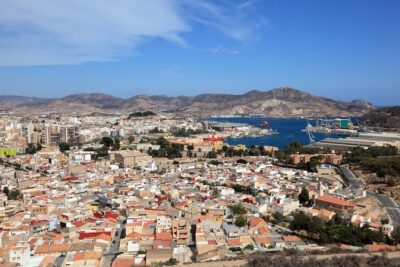
The main reward here is the view over Cartagena. You can get your bearings quickly: the harbor, old center, surrounding hills, and compact urban core become easier to understand from above. For a first visit, that viewpoint can make the later walking portions more meaningful.
Admission to the castle is not included. The description specifically promises the panoramic elevator, Torres Park, and an exterior view, so do not assume you will receive a full interior castle visit. The 20-minute timing also favors a quick orientation rather than a long exploration.
Entering the Roman Theater Museum
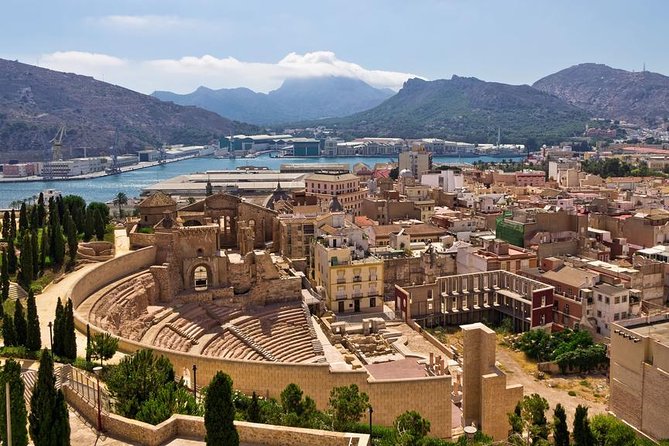
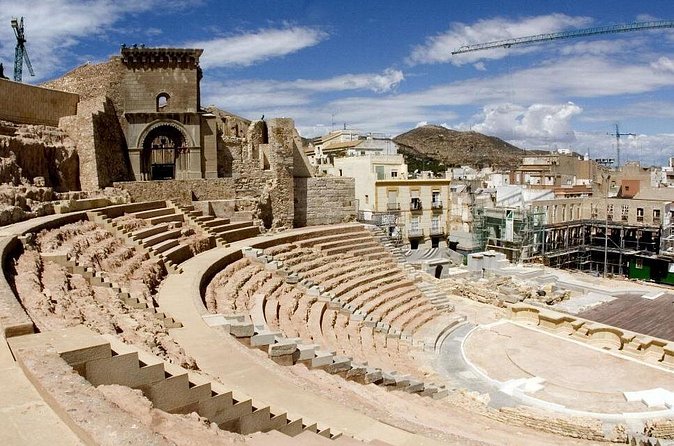
The Roman Theater is the centerpiece of the experience. Your 40-minute visit includes admission to the theater and museum, so there is no separate ticket to arrange for this major stop.
Built between 5 and 1 BC, the theater held about 7,000 spectators. It remained in use until the third century, after which later buildings were built over it. The site was uncovered in 1988, and much of the theater was cut into the rock.
The museum, designed by architect Rafael Moneo, leads you into the monument rather than treating it as an isolated ruin. That design matters. You first learn how the site was found and interpreted, then move toward the ancient theater itself. The building turns the monument into part of the museum experience.
This is where a guide adds real value. A large Roman theater can look like rows of stone unless someone explains its seating, stage, audience capacity, and place in Roman Hispania. The best feedback about this tour centers on this stop and on David’s explanations. He was described as warm, entertaining, and good at making the history easy to follow.
Forty minutes is a useful but firm limit. You should be able to see the main museum route and theater, but you will not have unlimited time for every display. If ancient sites are your priority, keep your questions focused and tell the guide early that you want a serious look at the Roman remains.
Same port, a different plan for the day:
- Arrecife: Timanfaya and Green Lagoon for Cruise Passengers
★ 4.6 · 2,010 reviews - Timanfaya And El Golfo For Cruise Passengers (Mornings)
★ 4.5 · 944 reviews - Lanzarote: Day Tour for Cruise Passengers
★ 4.7 · 860 reviews - Fuerteventura: Corralejo Sand Dunes Guided Shore Excursion
★ 4.6 · 335 reviews
Cartagena’s modernist city center
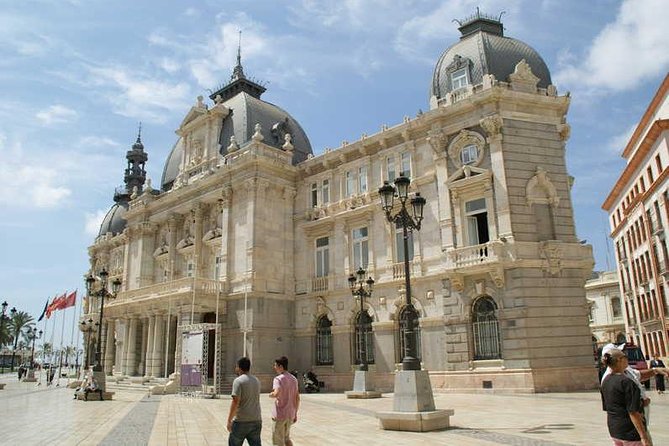
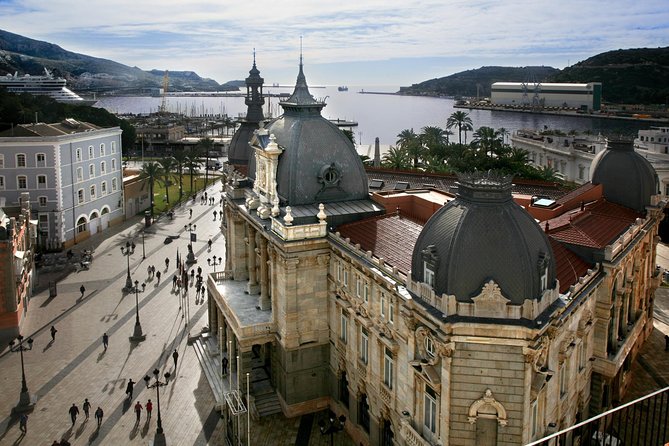
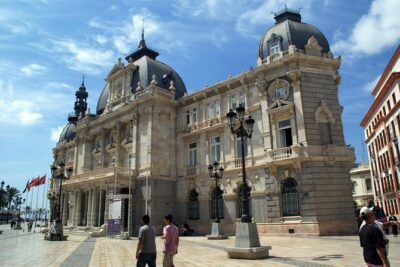
The route includes the Consistorial Palace, Cartagena’s city hall, and an impressive eighteenth-century building on the main pedestrian street of the old center. These stops are listed as exterior visits rather than full museum entries.
The Consistorial Palace was built between 1900 and 1907. Its triangular form, white marble facade, zinc domes, and repeated city emblems make it an easy building to appreciate even during a short walk. The castle of the Conception and the mural crown appear in Cartagena’s symbols, linking this modern building to the city’s older identity.
This part of the tour gives your eyes a break from ruins. Cartagena is not only an archaeological site. Its later wealth and civic pride show in the architecture around the pedestrian center.
The eighteenth-century building is not identified by name in the supplied details, so your guide will need to provide that context on the day. Treat this section as a compact walking introduction rather than a formal interior tour. It is useful for seeing how the old center fits together, but the schedule does not promise extended time inside either building.
The Molinete Archaeological Park and Roman government
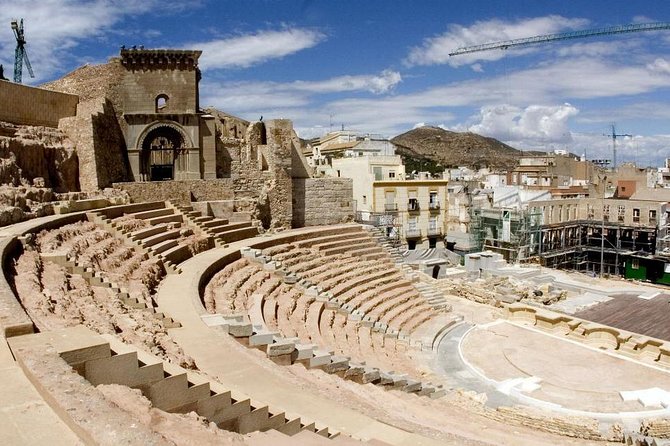
The Cerro del Molinete Archaeological Park receives about 40 minutes. Admission is listed as free, and the site reveals how Roman Carthago Nova functioned as a city, not just as a collection of monuments.
The Roman forum lay near the center of town, where main roads met between the hills. Excavations have revealed part of that civic zone, including a temple to Jupiter, Juno, and Minerva, known as the Capitoline triad. The site also includes the Augusteum, the curia where the colonial government met, baths, a palestra, and a temple of Isis.
This is a good stop for putting the Roman Theater into a wider setting. At the theater, you see public entertainment. At Molinete, you see religion, government, exercise, and city planning. Together, the two sites show how Roman urban life worked.
The archaeological park is not as instantly dramatic as the theater, and some structures require explanation. That is another reason to stay close to the guide. Forty minutes should give you a clear look at the main remains without turning the visit into a long archaeology lesson.
The Punic Wall and the birth of Qart Hadast
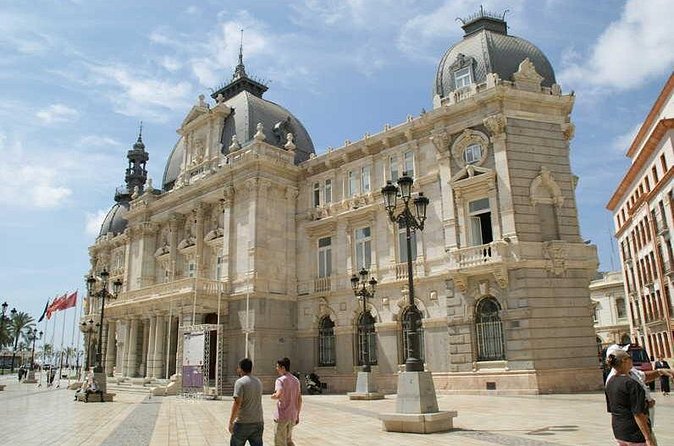
The Punic Wall offers one of the most unusual historical links in Cartagena. It recalls the Punic Wars between Carthage and Rome and the founding of Qart Hadast by Hasdrubal in 229 BC.
This is one of the few Carthaginian remains in Spain. That fact gives the stop weight. Much of the city’s ancient story is Roman, but the wall takes you back to the power that came before Rome controlled the region.
Next to the wall is a burial crypt beneath the Hermitage of San José, built in the sixteenth and seventeenth centuries. Its painted program includes the Dances of Death, a striking later layer beside the ancient fortification.
The scheduled visit lasts 15 minutes, and admission is not included. That is enough for a concentrated look and a short explanation, but not a long museum visit. If the Punic period interests you, ask the guide to place the wall in the wider conflict between Carthage and Rome.
ARQUA and the Odyssey treasure

The final listed stop is the National Museum of Underwater Archaeology, known as ARQUA. The visit is scheduled for 45 minutes, but admission is not included.
ARQUA studies, protects, researches, preserves, and presents Spain’s underwater cultural heritage. Its most famous collection is the Odyssey treasure from the frigate Nuestra Señora de las Mercedes: more than 570,000 gold and silver coins from the late eighteenth and early nineteenth centuries.
This museum adds a modern legal and scientific side to Cartagena’s maritime story. You are not only looking at objects recovered from the sea. You are also seeing how underwater heritage is studied and protected.
The 45-minute slot allows a useful introduction, though the extra admission charge matters when judging the total cost. If your group has limited interest in naval or underwater archaeology, you might prefer to spend more time at the Roman Theater or old center. Since the tour is private, you can discuss that preference with the guide, although the full route includes several scheduled stops.
What $487 per person really buys
At $487 per person, this is an expensive shore excursion. The price makes more sense for a group that values private transport, a dedicated guide, port pickup, and a tailored pace. It is harder to justify for one or two people who are comfortable using public transport and visiting Cartagena independently.
The package includes four hours of a private vehicle with driver, a private official guide, local taxes, pickup and return at the cruise port or hotel, and admission to the Roman Theater and its museum. Food and drinks are not included, and the other listed admission fees are separate.
The value is mainly in time and coordination. You do not need to work out how to connect the port, hilltop, old center, archaeological park, and museums. A private guide can also shape the emphasis around Roman history, naval subjects, or the city’s architecture.
There are limits. Four hours is short for six major stops. You will see a lot, but several visits are brief, and the castle is described as an exterior visit. Before booking, decide if you prefer broad coverage or a slower visit to two or three places.
Guide quality, language, and the private format
David is the guide named in the available feedback, and he receives the strongest praise. His style was described as warm, entertaining, and informative, with a well-paced walk that suited a group of retirees. That is useful information if you want history explained without a rushed lecture.
One other review says the guide was informed but struggled somewhat with English. The tour is offered in English, but language comfort can vary. I would contact the provider before booking if clear English explanations are essential, and ask if David is available for your date.
The private format means only your group participates. That makes it easier to ask questions, pause for photos, or request more time at the Roman Theater. It does not guarantee that every stop will become flexible, since the route has many scheduled locations and a four-hour limit.
The driver issue should not be ignored. One customer reported a rude attitude and poor communication. The provider apologized, attributed the incident to a Spanish-English misunderstanding, and stated that the driver had been removed. That response is reassuring, but you should still confirm the current driver and communication arrangements before your port day.
Who should book this Cartagena shore excursion?
I would recommend it to a private group that wants a guided overview and does not want to manage transport during a short port call. It suits people who want Roman Cartagena explained properly, while still seeing the Punic Wall, naval museums, city hall, and hilltop view.
It is also a good fit for groups with mixed interests. One person can enjoy Roman archaeology, another can focus on naval history, and everyone gets a look at the old center and the view from Torres Park.
I would think twice if your budget is tight, if you want long visits at each museum, or if you are happy exploring independently. The additional entrance fees reduce the value, and the packed schedule means some stops will be introductions rather than full visits.
Pickup is available from a hotel, cruise port, or another chosen place in Cartagena. Confirmation is provided at booking, most people can participate, and the tour is near public transportation. Cancellation is free up to 24 hours before the local start time, with no refund for later cancellations or changes.
Should you book it?
Book this tour if your priority is efficient private sightseeing with the Roman Theater at its center. The guide, driver, and vehicle solve the practical problems of a short shore visit, while the route gives you a strong overview of Cartagena’s ancient and maritime past.
For the best value, book as a group, confirm the English-speaking guide, ask exactly which extra admissions you want, and verify the current driver arrangements. If $487 per person feels steep, choose a shorter private visit focused on the Roman Theater, old center, and castle view. If you want broad coverage with someone to explain the layers, this tour is a sensible, if costly, choice.
FAQ
How long does the Cartagena shore excursion last?
The tour lasts approximately four hours, including private guiding and private vehicle service.
Where can pickup take place?
Pickup and drop-off are available at the Cartagena cruise port, a hotel, or another chosen location in Cartagena.
Is the tour private?
Yes. Only your group participates in the private activity.
Is admission to the Roman Theater included?
Yes. Admission to the Roman Theater and its museum is included in the tour price.
Are all entrance fees included?
No. The Roman Theater admission is included, but other entrance fees, including those for the Castle of the Conception, Punic Wall, and ARQUA, are not included.
Is the tour offered in English?
Yes. The experience is offered in English. One available account says the guide struggled somewhat with English, so you may want to confirm the guide’s language comfort before booking.
Can I cancel for a full refund?
You can cancel at least 24 hours before the local start time for a full refund. Cancellations or changes made less than 24 hours before the start are not refunded or accepted.
More port days with a driver around Spain
- Private Shore Excursions to Rome from Civitavecchia Cruise Port with Driver
★ 5.0 · 118 reviews - Private shore excursion from Zeebrugge to Bruges with driver and guide
★ 4.0 · 12 reviews - 8 Hour Private Excursion Cruise Ship Pick up Tour Driver & Guide
★ 5.0 · 11 reviews - Chan May Shore Excursion To Hoi An By Private Car- Pro Driver
★ 5.0 · 4 reviews
Fresh shore excursions around Spain
- Alhambra Private Tour from Port of Motril★ 5.0 · 11 reviews
- Private Alhambra palace tour and Granada from Motril cruise port★ 4.5 · 3 reviews
- Motril Skip-the-Line Shore Excursion:Alhambra, Generalife Gardens★ 4.5 · 6 reviews
- Private Full Day Beaches Tour in Gran Canaria with Hotel/Cruise Port pick-up★ 4.5 · 3 reviews
- Private Shore Excursion in Gran Canaria★ 5.0 · 6 reviews
- Private Tour from the Port of Las Palmas to Teror Firgas Arucas★ 5.0 · 3 reviews
- Gran Canaria Premium Tour: Volcanoes and Wine for cruisers★ 5.0 · 16 reviews
- Arround Gran Canaria All Highlights Private Shore Excursion★ 5.0 · 11 reviews
Cartagena Shore Excursions, compared.
Cartagena and Murcia – full day shore excursion for cruise guests
Read our review →
Cartagena Unforgettable: Half Day Private City Tour (Also for Cruisers)
Read our review →
Murcia and Cartagena Shore Excursion Private Tour
Read our review →
Shore Excursion: Cartagena Half-Day Private Tour with transport
Read our review →Browse the lists this tour appears in